Unit circle diagram
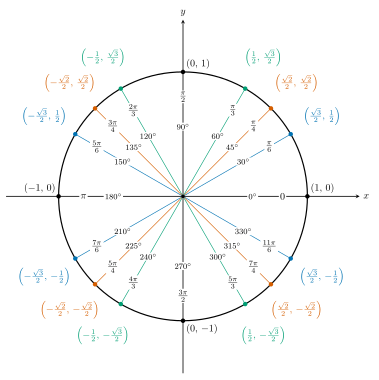
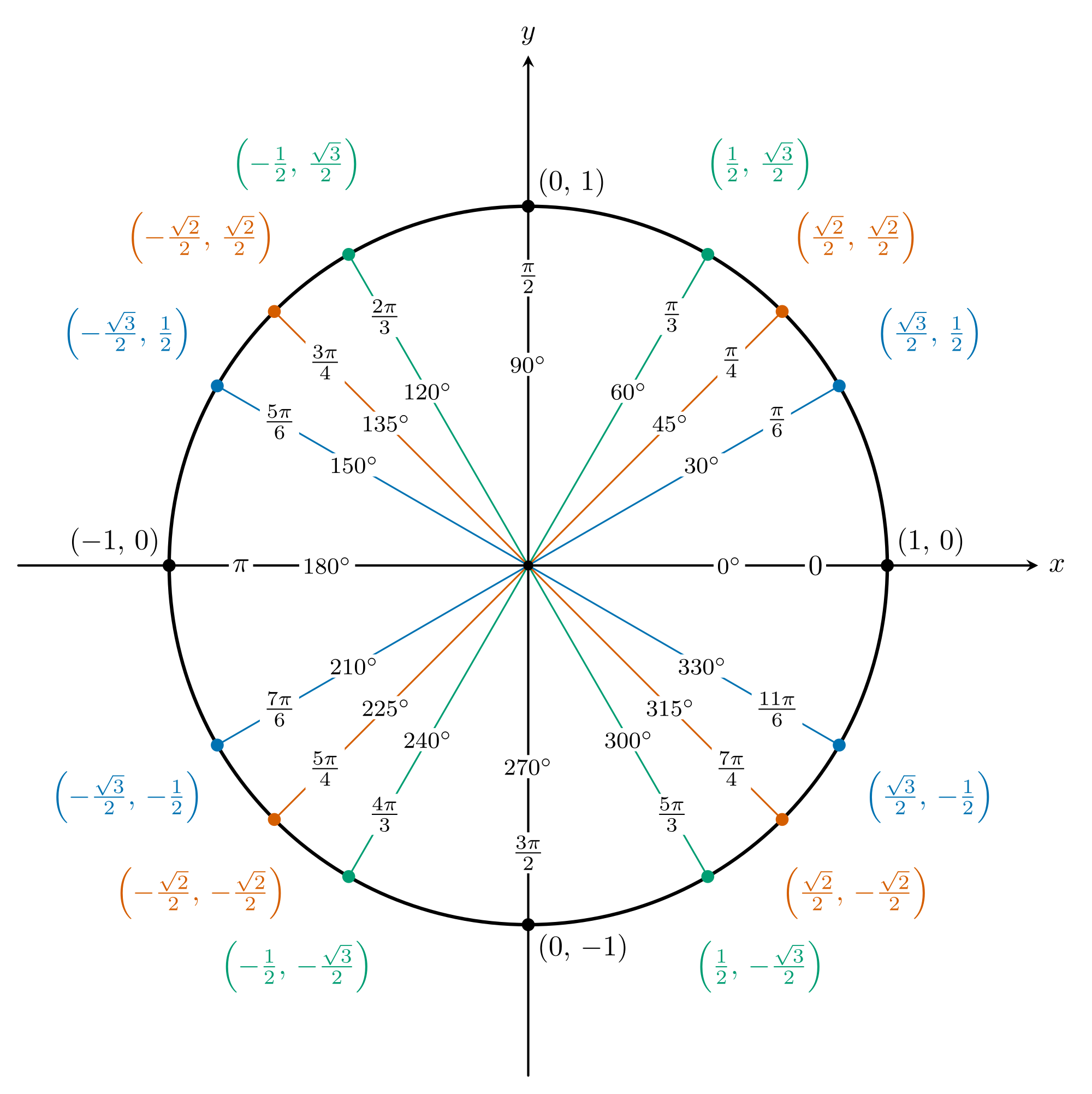
The unit circle is the circle of radius 1 centred on the origin. Every point on it is (cos θ, sin θ), where θ is the angle turned anticlockwise from the positive x axis. This diagram marks the 16 angles that trigonometry keeps coming back to, each in degrees and in radians, with the exact coordinates of its point.
Read it from the middle outwards: first the angle in degrees, then the same angle in radians, then, outside the circle, the point it lands on. Switch to the blank version to test yourself, or copy the TikZ code further down and change it.
Parts and what they mean
| Part | What it shows |
|---|---|
| The circle | Every point at distance 1 from the origin, so x² + y² = 1. |
| The angle θ | Measured anticlockwise from the positive x axis. A full turn is 360°, which is 2π radians. |
| Degrees | The inner ring of labels: the angle as a part of 360°. |
| Radians | The outer ring: the same angle as the length of arc from (1, 0) to the point. Half a turn is π. |
| The point (x, y) | Where the angle's line meets the circle: x = cos θ and y = sin θ. |
| The four points on the axes | (1, 0), (0, 1), (−1, 0) and (0, −1), at 0°, 90°, 180° and 270°. One coordinate is 0 and the other is 1 or −1. |
| The colours | Angles that share a reference angle share a colour: blue for 30°, orange for 45°, green for 60°. Their points use the same two numbers. |
Read the diagram as three numbers and a pattern of signs
You do not have to memorise 16 points. The first quadrant holds everything: 30° is (√3/2, 1/2), 45° is (√2/2, √2/2) and 60° is (1/2, √3/2). Only three numbers appear, 1/2, √2/2 and √3/2, and they are √1/2, √2/2 and √3/2 in disguise, so they count up.
Every other point is one of those three reflected into another quadrant, so the numbers stay and only the signs change. The x coordinate, the cosine, is negative on the left half of the circle. The y coordinate, the sine, is negative on the bottom half. The colours show which first-quadrant angle each point copies: 150°, 210° and 330° all use the numbers of 30°.
For the tangent, divide: tan θ = sin θ / cos θ, which is y / x. It has no value at 90° and 270°, where x is 0.
What the unit circle does not show
- The tangent and the reciprocal functions sec, csc and cot. Each is one division away from the coordinates.
- Angles beyond one turn, or negative angles. Add or subtract 360° (2π) until the angle is on the diagram: 405° lands on 45°, and −π/6 on 11π/6.
- Angles between the marked ones. Their cosine and sine are still the coordinates of a point on the circle, but there is rarely a neat exact value, so use a calculator.
- Circles of another size. On a circle of radius r the point is (r cos θ, r sin θ).
The TikZ code
This is the complete source of the diagram above. It compiles as it is with pdflatex, in LatexNotes, in Overleaf or on your own computer.
% Unit circle: the 16 standard angles in degrees and radians, each with its point (cos t, sin t).
% Compiles as it is with pdflatex. Free to use and change: latexnotes.tech/diagrams/unit-circle
\documentclass[tikz,border=6pt]{standalone}
\usepackage{amsmath}

% One colour for each family of angles that share a reference angle
\definecolor{thirty}{HTML}{0072B2}    % reference angle 30 degrees
\definecolor{fortyfive}{HTML}{D55E00} % reference angle 45 degrees
\definecolor{sixty}{HTML}{009E73}     % reference angle 60 degrees

\newif\iflabels
\labelstrue   % write \labelsfalse here for the blank version to fill in

\begin{document}
\begin{tikzpicture}[scale=4.4, >=stealth, line cap=round]
  % The axes and the circle of radius 1
  \draw[->, thick] (-1.42,0) -- (1.42,0) node[right] {$x$};
  \draw[->, thick] (0,-1.42) -- (0,1.42) node[above] {$y$};
  \draw[very thick] (0,0) circle (1);

  % The twelve angles off the axes: angle / radians / cos / sin / colour
  \foreach \a/\rad/\x/\y/\c in {
     30/\frac{\pi}{6}/\frac{\sqrt{3}}{2}/\frac{1}{2}/thirty,
     45/\frac{\pi}{4}/\frac{\sqrt{2}}{2}/\frac{\sqrt{2}}{2}/fortyfive,
     60/\frac{\pi}{3}/\frac{1}{2}/\frac{\sqrt{3}}{2}/sixty,
    120/\frac{2\pi}{3}/-\frac{1}{2}/\frac{\sqrt{3}}{2}/sixty,
    135/\frac{3\pi}{4}/-\frac{\sqrt{2}}{2}/\frac{\sqrt{2}}{2}/fortyfive,
    150/\frac{5\pi}{6}/-\frac{\sqrt{3}}{2}/\frac{1}{2}/thirty,
    210/\frac{7\pi}{6}/-\frac{\sqrt{3}}{2}/-\frac{1}{2}/thirty,
    225/\frac{5\pi}{4}/-\frac{\sqrt{2}}{2}/-\frac{\sqrt{2}}{2}/fortyfive,
    240/\frac{4\pi}{3}/-\frac{1}{2}/-\frac{\sqrt{3}}{2}/sixty,
    300/\frac{5\pi}{3}/\frac{1}{2}/-\frac{\sqrt{3}}{2}/sixty,
    315/\frac{7\pi}{4}/\frac{\sqrt{2}}{2}/-\frac{\sqrt{2}}{2}/fortyfive,
    330/\frac{11\pi}{6}/\frac{\sqrt{3}}{2}/-\frac{1}{2}/thirty}
  {
    \draw[\c, semithick] (0,0) -- (\a:1);
    \fill[\c] (\a:1) circle (0.018);
    \iflabels
      \node[fill=white, inner sep=1.2pt, font=\footnotesize] at (\a:0.56) {$\a^\circ$};
      \node[fill=white, inner sep=1.2pt] at (\a:0.80) {$\rad$};
      \node[\c] at (\a:1.29) {$\left(\x,\,\y\right)$};
    \fi
  }

  % The four angles on the axes: angle / radians / point / where its label sits
  \foreach \a/\rad/\pt/\pos in {
      0/0/{(1,\,0)}/above right,
     90/\frac{\pi}{2}/{(0,\,1)}/above right,
    180/\pi/{(-1,\,0)}/above left,
    270/\frac{3\pi}{2}/{(0,\,-1)}/below right}
  {
    \fill (\a:1) circle (0.018);
    \iflabels
      \node[fill=white, inner sep=1.2pt, font=\footnotesize] at (\a:0.56) {$\a^\circ$};
      \node[fill=white, inner sep=1.2pt] at (\a:0.80) {$\rad$};
      \node[\pos, inner sep=3pt] at (\a:1) {$\pt$};
    \fi
  }
  \fill (0,0) circle (0.014);
\end{tikzpicture}
\end{document}
- For the blank version, change
\labelstrueto\labelsfalse. - The three
\definecolorlines set the colours of the angle families. Set all three to black for printing. scale=4.4is the circle's radius in centimetres: change it to resize the whole diagram.- Each angle is one row of the list: delete a row to drop an angle, or add one in the same pattern.
Drew your own diagram by hand?
LatexNotes turns a photo of your handwritten notes into LaTeX, and redraws hand-drawn graphs and diagrams as editable TikZ and pgfplots, like the code above.
Frequently asked questions
Why is 180° equal to π radians?
A radian measures an angle by the length of arc it cuts from a circle of radius 1. The whole circle is 2π long, so a full turn is 2π radians and half a turn, 180°, is π. To convert degrees to radians, multiply by π/180.
How do I remember the unit circle?
Learn the first quadrant only. For 30°, 45° and 60° the sines are √1/2, √2/2 and √3/2, counting up, and the cosines are the same numbers counting down. Every other point reuses those numbers with the signs of its quadrant.
Why is the x coordinate the cosine?
Drop a line from the point straight down to the x axis. It makes a right-angled triangle whose hypotenuse is the radius, 1. Cosine is adjacent over hypotenuse, which is x over 1, and sine is opposite over hypotenuse, y over 1.
Can I use this diagram in my own notes?
Yes. Download the picture, or copy the TikZ code and change it as you like. It is free to use in notes, slides and worksheets.